Samples are a great idea but …
A single sample is the weaving equivalent of a scientific experiment: the goal is to learn what happens, and learning that something doesn’t work is just as useful as finding out that it does. It’s much better to learn that in advance, on a small scale, before committing time, energy and yarn to a larger project and risking major disappointment.
For example, suppose you’re planning a project with Twill 1 using a specific yarn at a specific sett, and you want to know whether that combination will work. What will the fabric feel like? Will it actually look like the drawdown or will the threads shift around? How much dimensional loss will you have, and therefore how long and wide should the woven cloth be on the loom?
If you know these things in advance, you can make sure your project is perfect. If you discover that the twill you chose doesn’t look like you expected or feel like you’d hoped, you can change your plans and save yourself heartache.
The way to answer these questions is to weave a sample in that yarn, at that sett, and to see what happens. That takes time and effort, though, and gives you information about just one twill. Unless you especially like weaving samples, that can be hard to talk yourself into.
There’s another catch as well: a narrow sample warp won’t behave the same way as a wider project warp. The weft will beat in more, and you’ll almost certainly have a higher percentage of width-wise dimensional loss. The only way to be sure you’re getting numbers you can rely on is to weave a sample as wide as the project will be.
If you’ve got to weave that wide anyway, wouldn’t it be better to get information about a dozen twills instead of just one?
Enter the gamp!
A gamp is an entire set of samples woven all at once, in a single piece of cloth. Rather than threading one thing and treadling it one way, you choose several threadings and several treadlings and test them all at once.
Getting back to our example, suppose Twill 2 had been a contender for your project, but after some debate you chose Twill 1 instead. And maybe Twills 3 and 4 have also caught your eye and you’ve bookmarked them for some future project.
Rather than weaving a sample of only Twill 1, you can thread all four twills side by side, then weave them all in a row. It takes a little more time threading and a little more time weaving, but you’ll get woven samples of all four twills at the same time. You’ll be able to verify your choice to use Twill 1 instead of 2, or you might discover you like 2 better after all! You’ll also gain the info you need to plan future projects with Twills 3 and 4 now, without having to weave another sample later.
Way more bang for your weaving buck
But wait: there’s more! Getting four samples for the “price” of one is a pretty good deal, but a gamp actually gives you way more than that.
Look what happens when you weave the project described:
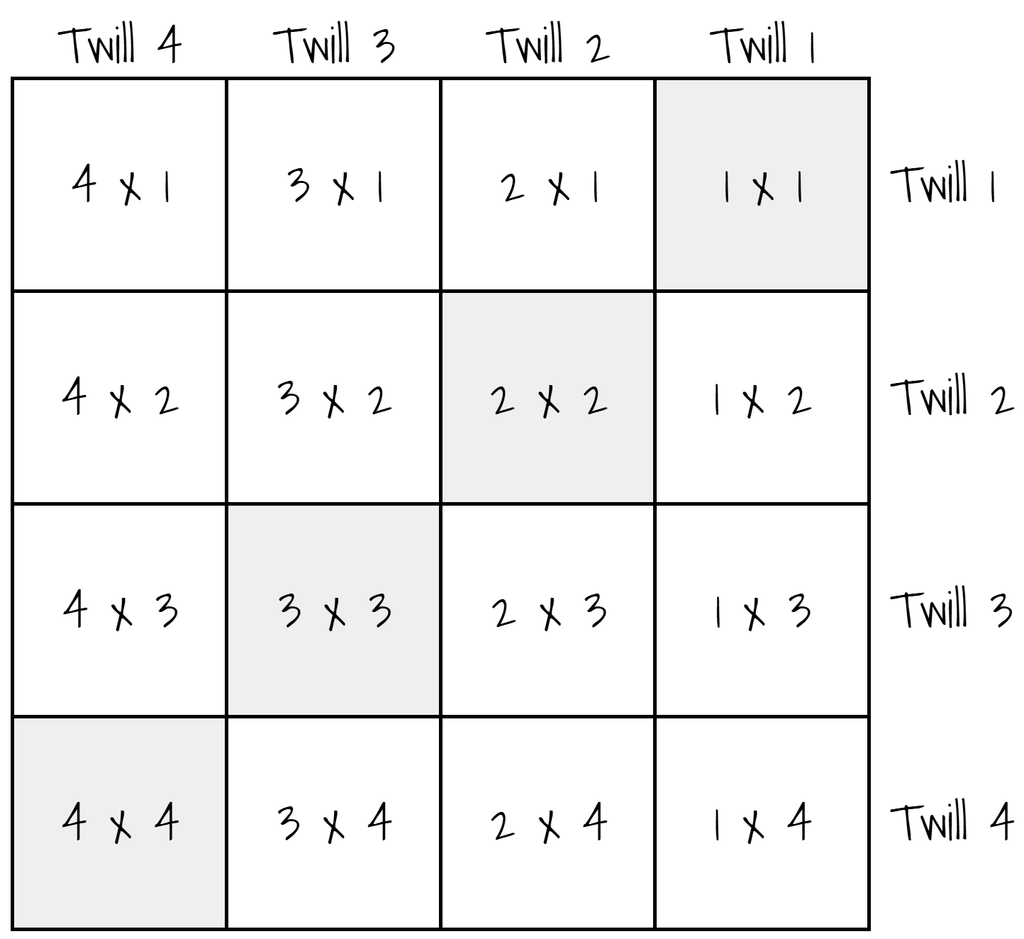
The four samples you planned are on the diagonal, where Twill 1’s threading crosses Twill 1’s treadling, and so on. Off the diagonal, you’re in unplanned and uncharted terrain. In the top left corner, for example, you get the threading for Twill 4 crossed by the treadling of Twill 1. That wasn’t part of the plan – you get those results for free!
Choosing four different twill threadings and weaving them as drawn in actually gives you woven samples of 10 different twills, not just four. (4×1 is the same as 1×4 apart from color if both are woven as drawn in.) If you’re not treadling as drawn in, you wind up with 16 entirely different twills, all for just a little more effort than weaving a single sample – and closer to the width of an actual project.
Depending on how you design the gamp, you also get narrow bands where one twill transitions into another, and those often turn out to be just as interesting as the 10 or 16 samples themselves.
Not one, not even four, but up to 16 different twills, all in a single piece of fabric. You’ll know how each behaves, how they feel, what they look like woven up – including 12 twills you didn’t even have a draft for to begin with.
This one piece of cloth contains all the inspiration and information you need to plan dozens of projects, not just the one you’re sampling for Right Now.
Designing a gamp
There’s a little more to designing a gamp than just bunging four threadings side by side and four treadlings in a stack and going to town. How do you connect things up? Should the sections be the same size or are different sizes okay? What colors should you use? Should you put dividers between sections or let them run directly together? Which twills should you put next to each other? For that matter, can you add ANY twill, or are there some restrictions?
You can spend as much or as little time answering these questions as makes sense for the set of samples you’re working on. Fair warning, though: gamps can be addictive! You might find yourself designing gamps that are projects themselves! Gamps make great napkins, towels – even blankets, shawls, or beautiful scarves like Miriam Lebby’s.