This post was graciously written by community member Laura Fry, master weaver, teacher and author of Magic in the Water. For more information about weaving ergonomics, see these companion posts: How to thread your loom faster and How to sit at the loom while weaving.
How to handle your shuttle for ergonomic weaving
Holding the shuttle is recommended to be underslung – cradled in the fingers – not overhand.
Our arms have two bones in the forearm. If you hold the shuttle overhand, the lower arm needs to rotate, which means the two bones are no longer in parallel alignment but must twist around putting the thumb in the downwards pointing position. This is generally accepted to be tiring plus it removes the thumb from being able to help with breaking the motion of the bobbin.
The movement required to ‘throw’ the shuttle when it is held cradled in the fingers is a simple flick of the index finger, not requiring the whole are to impart the force required to get it from one selvedge to the other, especially on a wide warp.
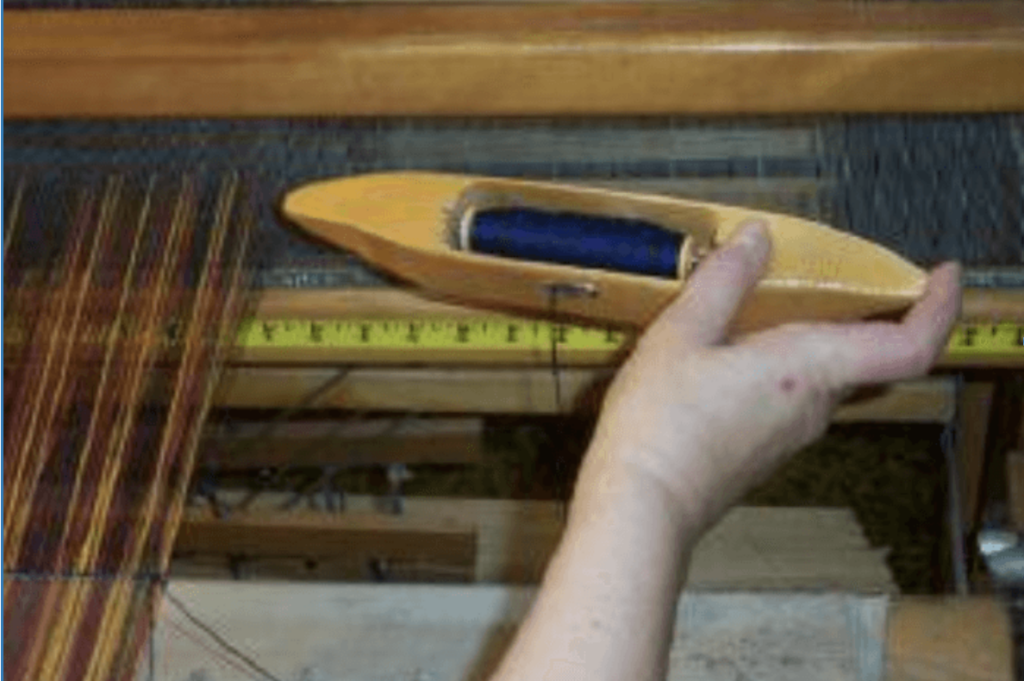
This photo shows the position to ‘throw’ the shuttle with the thumb stabilizing the shuttle and the index finger on the point. This is a Leclerc shuttle and if you have small hands, you may find a smaller sized shuttle more comfortable.
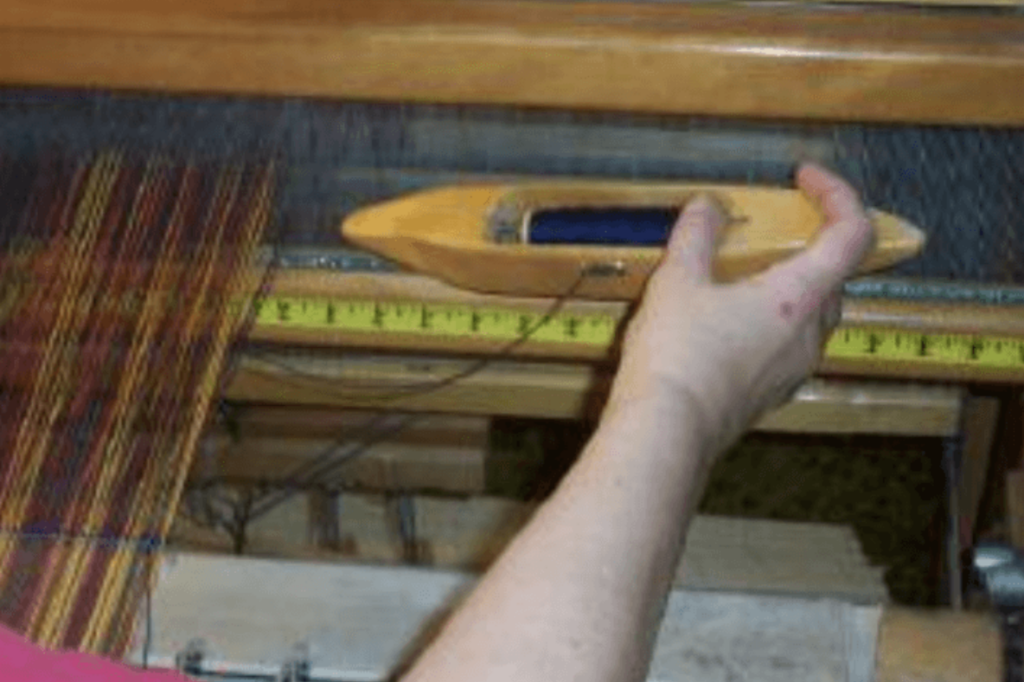
This photo shows how the shuttle is ‘caught’ – allow it to slide between the index and middle fingers, using the thumb to brake the rotation of the bobbin to prevent excess cast off of the yarn. When the weft is ‘beaten’ into place, make sure that your hands lift the shuttle so the beater doesn’t hit your hand and keep the shuttle forward of the fell.
If the shuttle is held ‘overhand’ the position of the shuttle and your arm will change from a more neutral position to one that requires more ‘work’ for your body. On a wider warp, you will have to reach farther and use more force, generated by your entire arm.
On a 60” wide warp, I can easily ‘throw’ the shuttle using the above method with little effort and fatigue.
Paying attention to what we are doing and how much effort it takes will help determine which processes might need to be adjusted to make them less tiring.
There are other areas in the studio that could potentially be made more ergonomic, but the ones covered in this 3 part series are the ones that seem to provide the most difficulty for many weavers.
Pay attention to your body. If something starts to hurt, stop and do something else for a while. Weaving is full of repetitive motions. Much better to NOT develop an inflammatory injury than it is to recover from one.
Above all, enjoy what you are doing. If you aren’t? Try to find a different way to do the task that is proving to be a problem.
Happy weaving!