
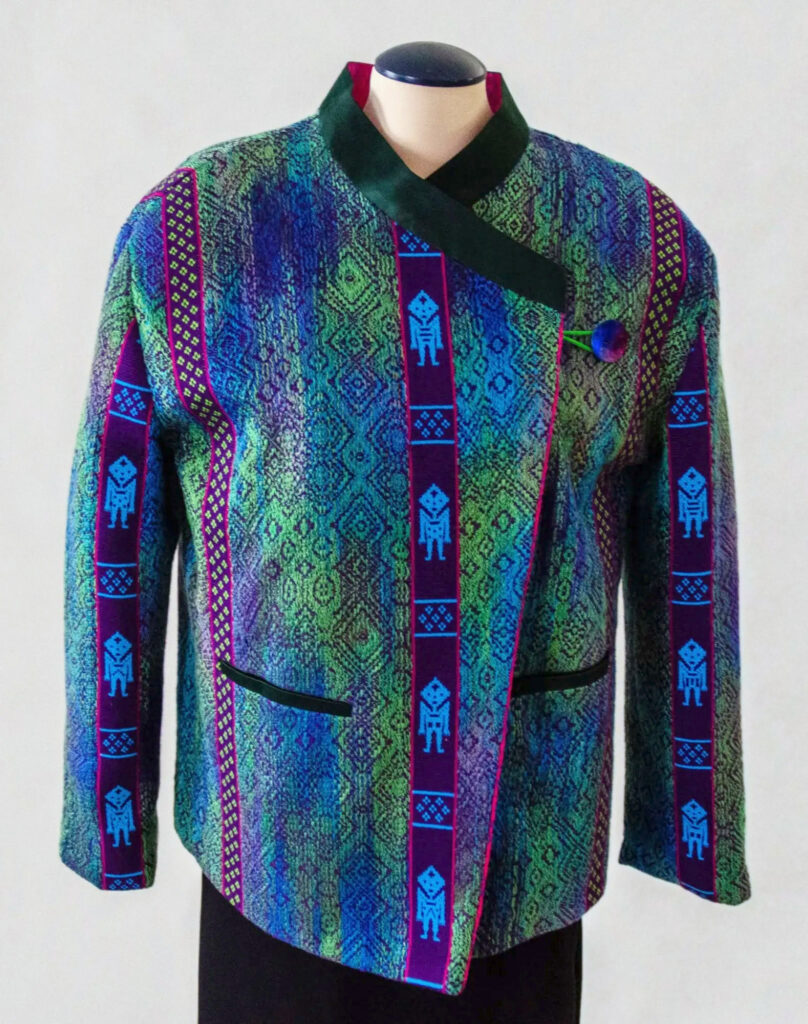
A couple of weekends ago I hosted a three day workshop on incorporating tablet woven bands into shaft loom fabric, taught by Master Weaver (and first place winner of this year’s Convergence ‘Krewe of Threads’ fashion show!), Inge Dam. It was an amazing opportunity, especially since Inge told us that she was officially retiring from teaching after our workshop ended. (I’m 99% sure this was a decision she’d already made – I don’t think we drove her to it!)
You might think that an ancient technique from the Bronze age done with bits of bone or stone is less complex than what we do today with dozens of shafts, but you’d be wrong. Shaft loom weaving is mostly binary: a thread goes up or it goes down. If it’s up, one thing happens. If it’s down, something else happens. That’s a huge oversimplification, but at its heart, shaft loom weaving comes down to which threads are up and which are down. Two states. (That’s assuming continuous, selvage to selvage weft and that everything is loom controlled, of course. If you get into finger manipulated weaves, all bets are off.)
For someone whose brain is good at numbers and patterns and systems, keeping track of shaft loom weaving is sort of like counting cards: complex, but logical. Doable.
In tablet weaving, the thing that makes the shed is a tablet instead of a shaft. A tablet has just four holes (usually), as compared to oodles of heddles on a shaft, and therefore has just four threads (usually!) rather than dozens or hundreds.
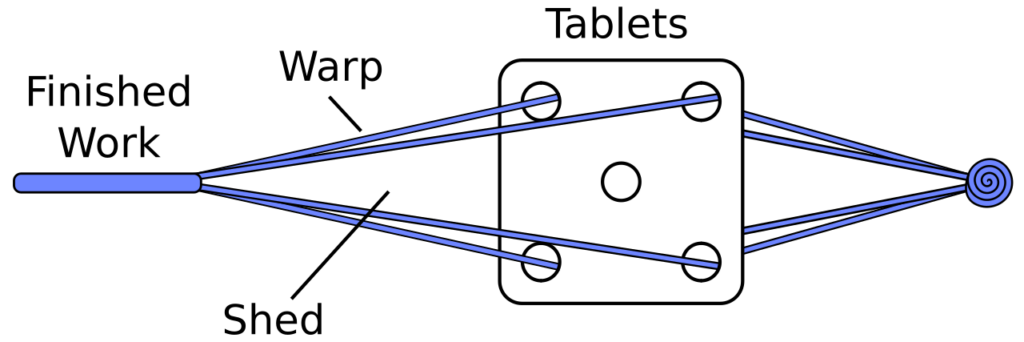

You pop a thread into each of the tablet’s holes (usually!!) and turn the cards to add twist, like plying those four strands together into a single, thicker cord. The holes also divide the ends into layers, forming a shed; the weft goes through that shed to lock the twist into place and keep the cord from uncording. Two of the warp ends appear on top and the others appear on the bottom. If the threads are different colors, patterns form in the cord, like a barber pole. If they’re all the same color, the cord is a solid color.
Turn, twist, lock. Simple, right?
Well, here are some more variables:
- A tablet can turn in either direction, forward or back. One direction adds twist, the other removes it. Except after the weft locks the twist in place, both directions add twist, in opposite directions.
- A tablet can turn multiple times between weft picks, or not at all. Because of the direction thing, three turns forward is not the same as one turn back, even though it puts the threads in the same place.
- A tablet can be threaded in one of two ways, S or Z. That choice affects both the direction of twist and the order in which the colors appear in the cord.
- A tablet can switch between forward and back or S and Z at any time.
- Tablets even can be rearranged, I think, at least to a limited degree. (This is definitely above my tablet weaving pay grade!)
- These choices can change at every weft pick!
What’s more…
- A band is made with a whole whack of tablets side by side, and the weft binds them all together in parallel, so that the colors in one cord combine with that of its neighbours to form the overall design.
- Each tablet in the band can make any of these choices independently. Forward or back; S or Z; turn, turn again, or stay put; move to another spot in the band – each tablet can do its own thing regardless of what its neighbours are doing.
That is so. many. variables! It’s the opposite of binary! My noodle is pretty good at “counting the cards” of shaft loom weaving, but this is like having the deck shuffled after every pick. Oh, and also it’s a Korean hwatu deck with 12 suits, the game is Go-Stop, and I don’t know the rules.
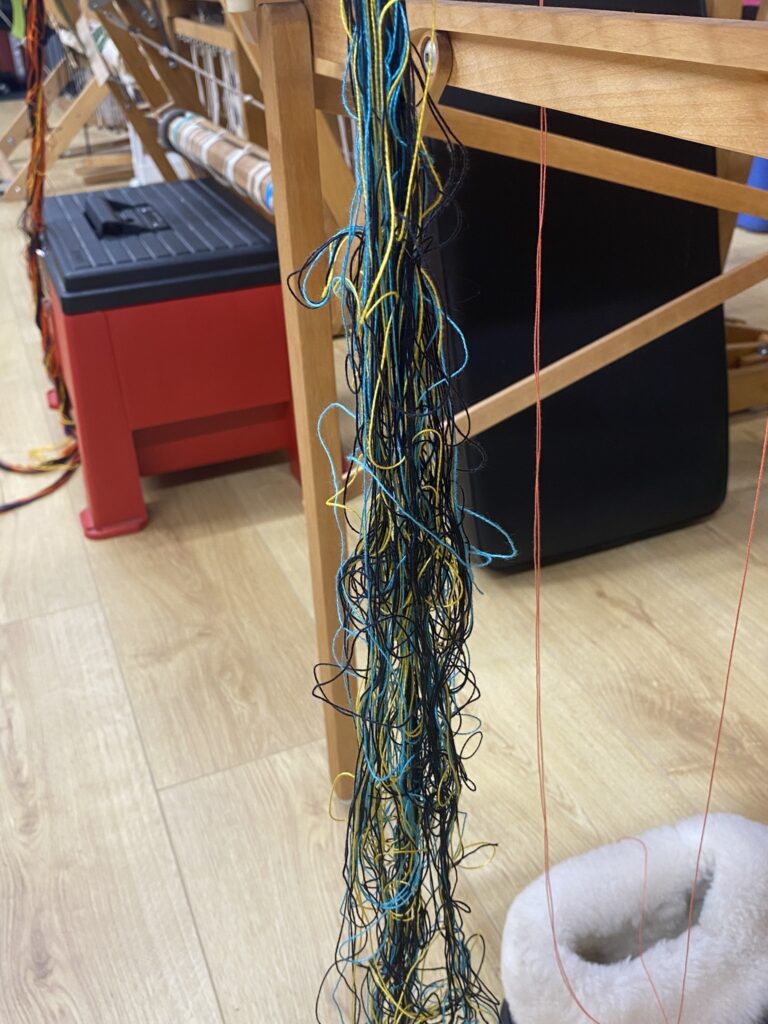
And all of that is just the tablet band. Inge does all this in the middle of shaft loom woven fabric. With multiple bands at a time! Doing different things! And complex twills in the background! That’s like rubbing your head and patting your tummy at the same time, while also playing the piano and juggling knives.
We did not play the piano or juggle any knives in our workshop. We were thoroughly impressed by Inge’s piano and knives but we only attempted the rubbing of heads and patting of tummies. Very slowly. With narrow warps, narrower bands, simple four shaft twill, and the most simple of tablet weaving options: every card moving in lock step, four times forward and then four times back. No rearranging, no flipping from S to Z. No fancy or funny business.
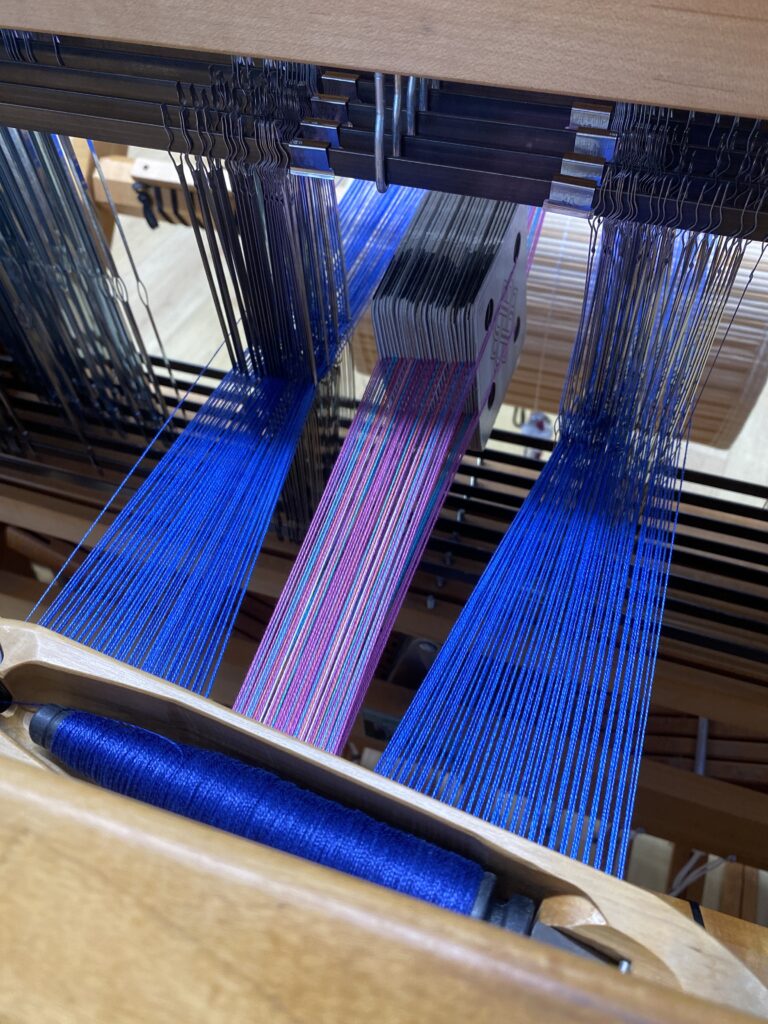
It still wasn’t easy. Minds and bodies (heads and tummies?) were stretched – as were some vocabularies, ahem. None of us wove very much, and none of our bands came out exactly as designed, I don’t think. I think it’s fair to say we all felt awkward and got frustrated at various times. But that’s part of learning anything new that takes skill: If it was easy to do, we wouldn’t have taken a workshop to learn how to do it.
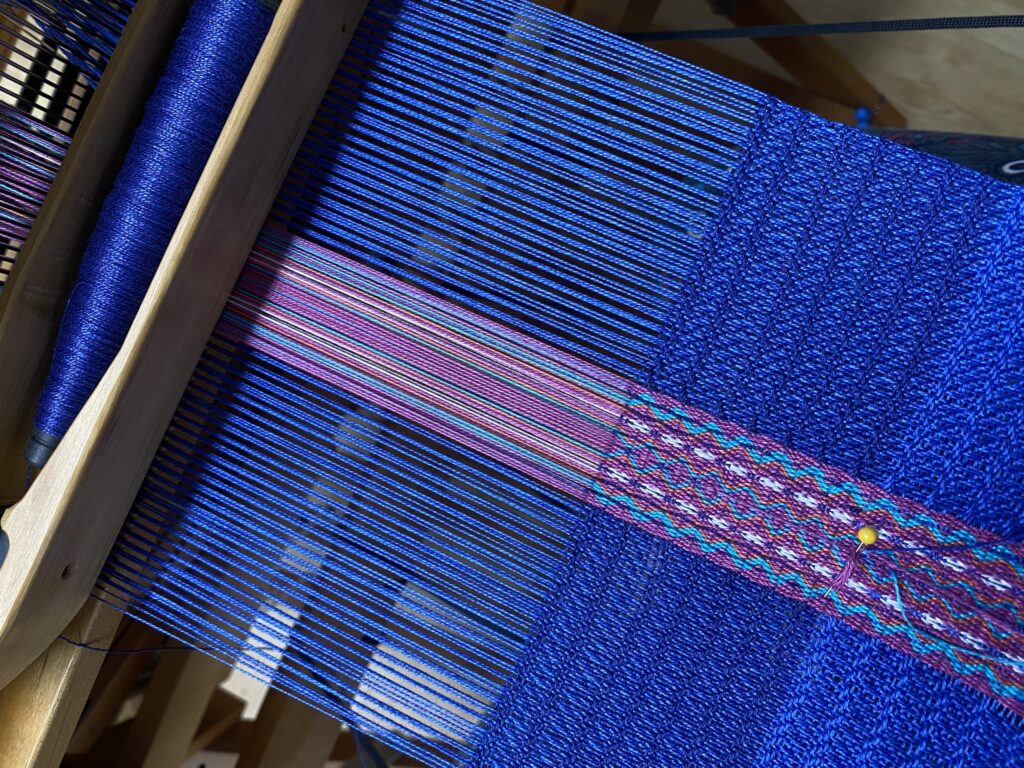
We also all had a great time and learned a lot, and we each were inspired in different ways. Some were inspired to continue with tablet weaving (with or without the surrounding fabric). I’ve been noodling on how I can trick out my loom or tablets to make putting the combined warps on the loom easier; I’ve also been reminded that slow cloth can be rewarding, and that speed and efficiency aren’t always the end all and be all. Others spent a thoroughly enjoyable weekend learning that they will probably never weave a tablet band again. None of those outcomes is a bad thing!
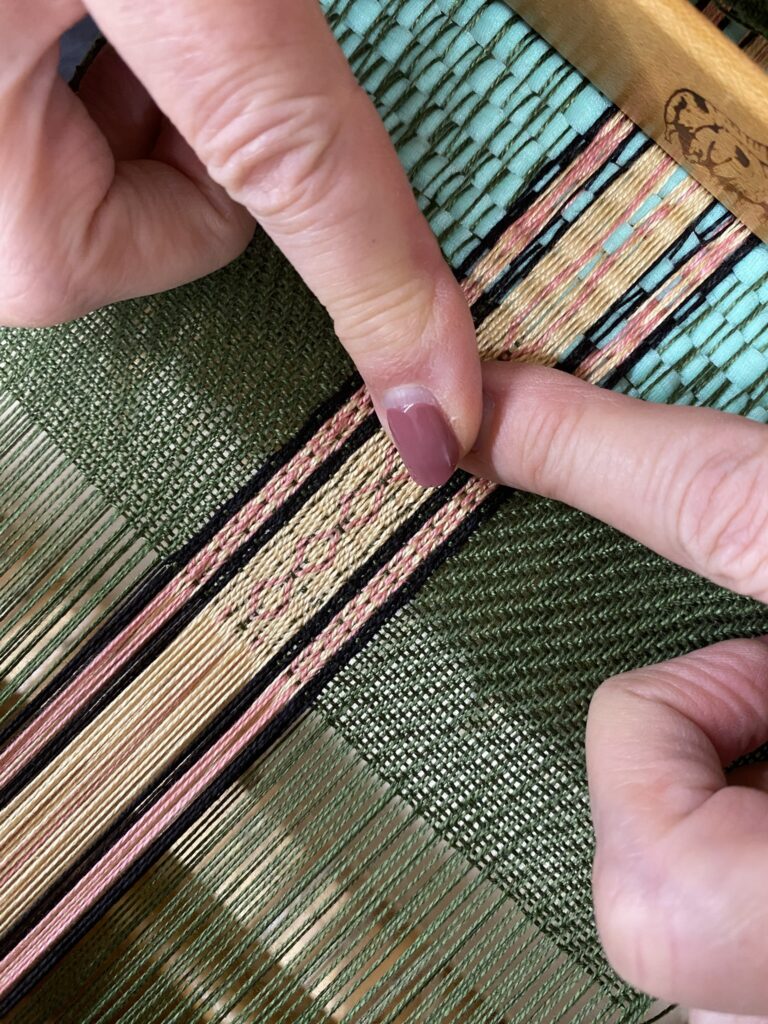
That’s the beauty of a workshop: You will always take something valuable away from it. Often it’s the skill you signed up to learn. Sometimes it’s a trick you pick up by watching other weavers at work. Sometimes it’s an introduction to a new group of weavers, or hot intel on a new book or piece of equipment. Sometimes it’s seeing how another teacher teaches. And sometimes it’s checking something off your weaving bucket list so you can move on and try something else.
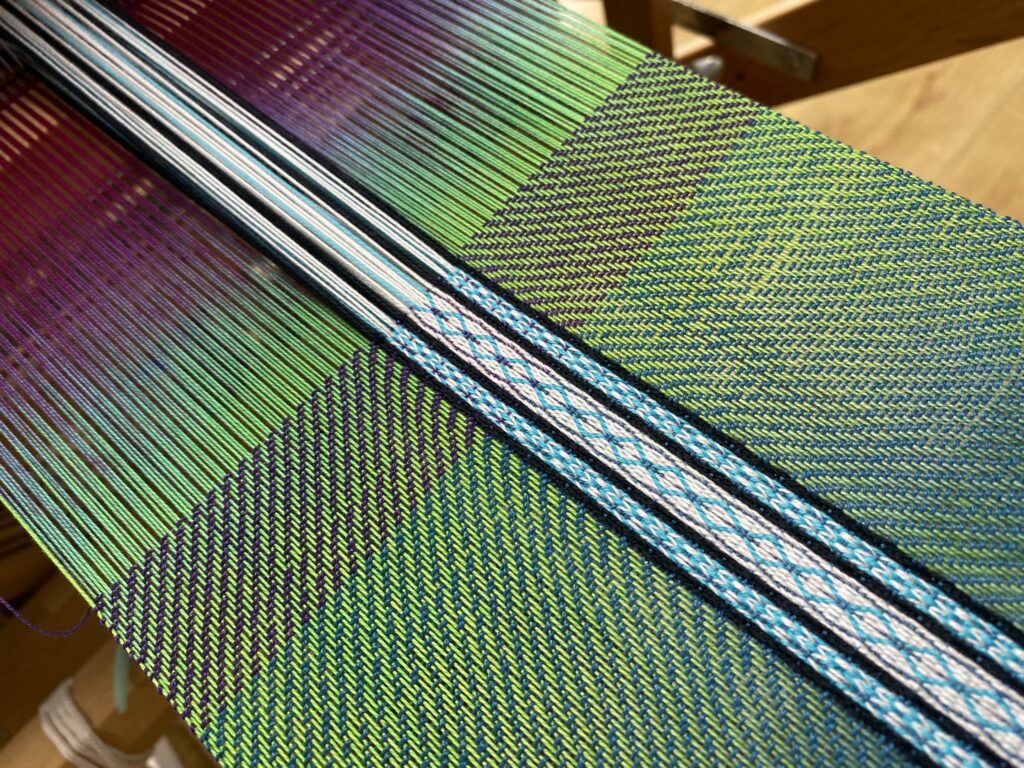
We will never know all there is to know about weaving. There are infinite rabbit holes to fall into. In the company of an expert like Inge, who’s both patient and quietly passionate about her topic, tours through exotic rabbit holes are inspiring and rewarding, even if you don’t plan to move in long-term. If you get a chance to take such a workshop, do yourself a favour and take it!
And now if you’ll excuse me, I have to go and reread the rules of Go-Stop.

Ron and I watch a lot of kdramas, and Go-Stop features in many of them. It’s played with a small deck of cards. Playing while sitting on a green blanket appears to be traditional, and throwing cards at the blanket (or at other players) often figures. I cannot say whether that’s a normal part of the game, or just part of the storyline of the tv show, but the Korean name for the deck translates as “flower battle,” so… ¯\_(ツ)_/¯