Suppose you have a threading that uses more shafts than you have available and you want to reduce it to fewer. One quick method to do that is by telescoping it.
This version of telescoping is twill specific! Though there are ways to telescope the threadings (and treadlings!) of other structures, it has to be done differently in each situation. The method described here is just for twills.
What is telescoping?
Telescoping is the process of cutting a threading into vertical bands, and then merging the bands together into one.
For instance, you might start with this…
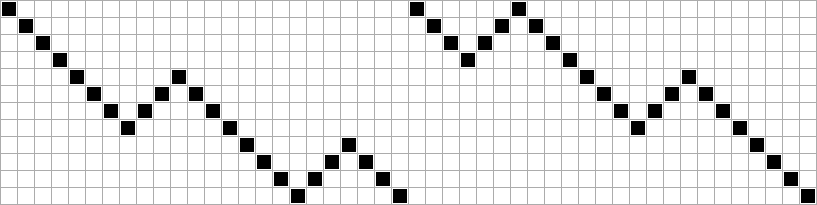
…separate it into bands four shafts high like this…
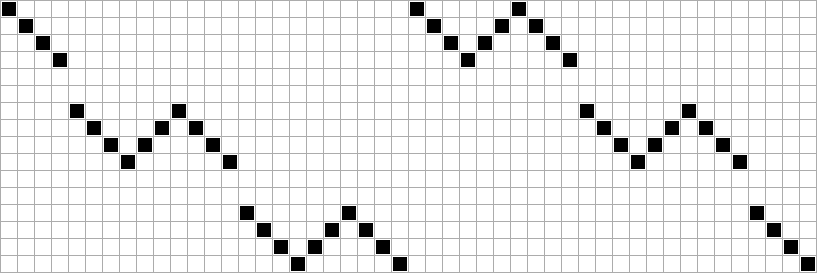
…then move the sections from the middle and top band down to the bottom band…
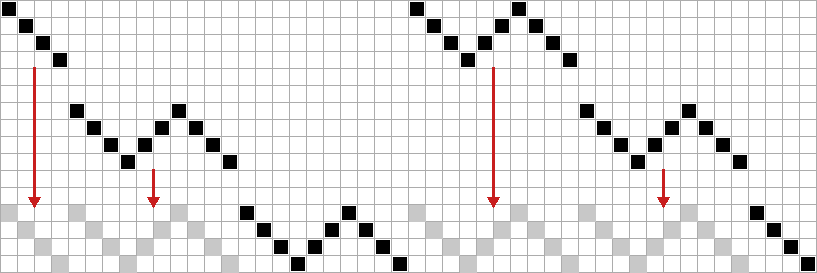
…and you wind up with this 4S threading:

The result will be a draft that’s similar in shape, though it will have less shading and more individual lines.
Compare these two drawdowns to see what I mean:
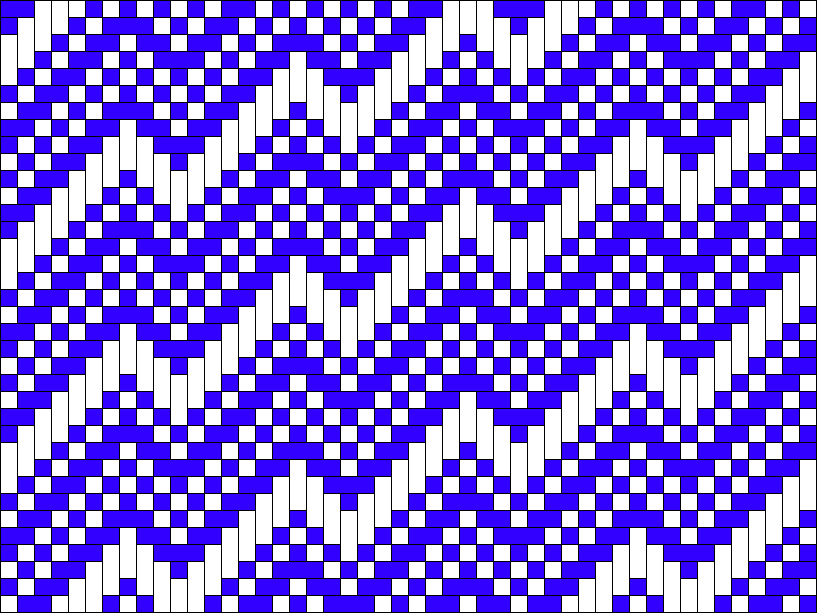
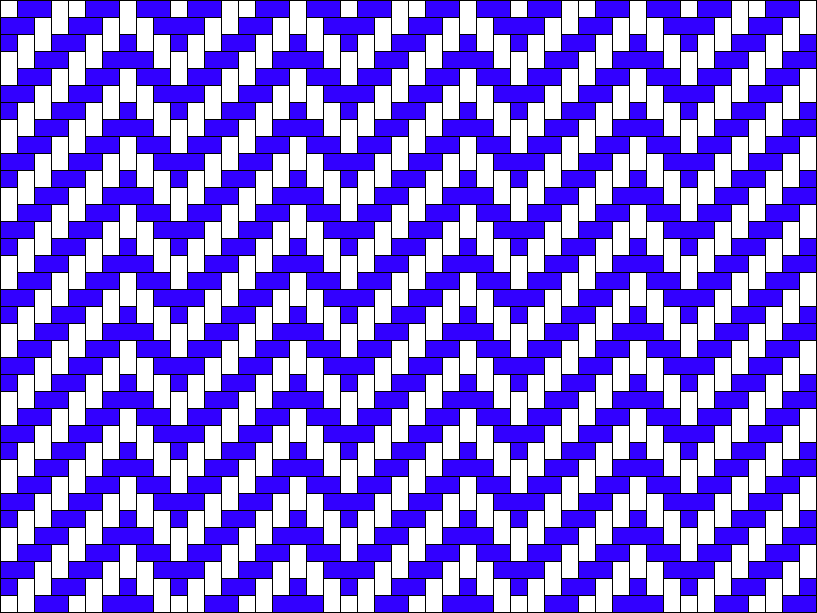
The four shaft version isn’t as exciting, true, but if you only have four shafts to work with, “less exciting” is better than “no can do.”
Telescoping in the Draft Editor
Telescoping a threading is really easy with the Draft Editor! The magic happens not in the threading, but in the tie-up.
All YOU have to do is give each “band” of the threading the same tie-up. The Editor will do the rest.
Suppose you want to telescope a threading down to four shafts. Here’s how to do it in 4 simple steps:
- Open the original draft in the Draft Editor.
- Copy Shafts 1-4 from the tie-up, then clear the tie-up entirely.
- Paste the shafts back into the tie-up, stacking one set on top of the other.
- Compact the draft.
Telescoping to 4
Here’s a short demo of those steps, using the draft above as an example.
Telescoping to divisors works best
In the previous example, we telescoped from 12 shafts down to 4. Four is a divisor of 12, which means you can divide 12 by 4 and not have any shafts left over.
Why is that important? Because it means that the design line will still connect properly after the threading is telescoped.
Notice that any thread on Shaft 12 in the original threading…
…is next to a thread either on Shaft 11 (its neighbour to one side on the twill circle) or on Shaft 1 (its neighbour to the other side on the twill circle).
When the design is telescoped down to four shafts…
…the threads that used to be on Shaft 12 are now on Shaft 4, and the threads that used to be on Shaft 11 are on Shaft 3.
Any thread that used to be on 12 is now on 4, and its neighbours to either side are either on Shaft 3 or on Shaft 1. Those neighbours are still side by side on the four shaft twill circle, so the design stays connected.
Telescoping from 12 to 8
If we telescope from 12 down to eight shafts, say, then this is what we get:

Once again, the threads that were on Shaft 12 are now on Shaft 4, and its neighbours are on Shafts 1 and 3. This is an eight shaft threading, though, and Shafts 1 and 4 are not neighbours on the eight shaft twill circle.
8 is not a divisor of 12 – if you divide 12 by 8, you get four shafts left over. (12 divided by 8 = 1 with a remainder of 4.)
It doesn’t matter how many times the target height will divide into the original height, nor does it matter how big the remainder is. The fact that there’s any remainder at all means that the resulting threading will have disconnected twill lines.
Maybe that’s okay! YOU get to decide whether having connected lines is important. If it is, you’ll either need to telescope to a number of shafts that’s a divisor of the original, or you’ll need to “massage” the resulting threading a bit to make things connect up the way you want.
Telescoping from 12 to 6
6 is a divisor of 12, just like four is, so telescoping down to six produces a connected twill threading:

Here’s a demo of telescoping the original 12 shaft design down to eight and also to six shafts:

From the Course Catalog:

Classic Twills – Where telescoping first comes up, in extended point twill.
Undulating Twills – Telescoping long, curving threadings down to fewer shafts.
Angled Twills – Telescoping steep and shallow twill lines.
Designing in the Tie-Up: Cookies and Clocks – Twill circles, and why divisors keep the design line connected.