If you’ve ever wondered how different twill threadings and treadlings interact with each other, or wanted to create a comprehensive reference library of twill variations, then you need to weave a gamp. Gamps are one of the most valuable tools in a weaver’s arsenal, offering insights that no computer simulation can provide.
What exactly is a gamp?

A gamp (originally British slang for an unwieldy umbrella), is cloth woven specifically to sample colors and structures under the “umbrella” of a reference project. While color gamps explore how different colors blend together, twill gamps take this concept further by comparing different structural variations.
In a twill gamp, different twill patterns are threaded side by side in stripes across the warp. Then, different twill patterns are woven one after another down the length of the cloth in the weft. The result? A grid of squares where each threading variation crosses each treadling variation, showing you exactly what happens when they meet.
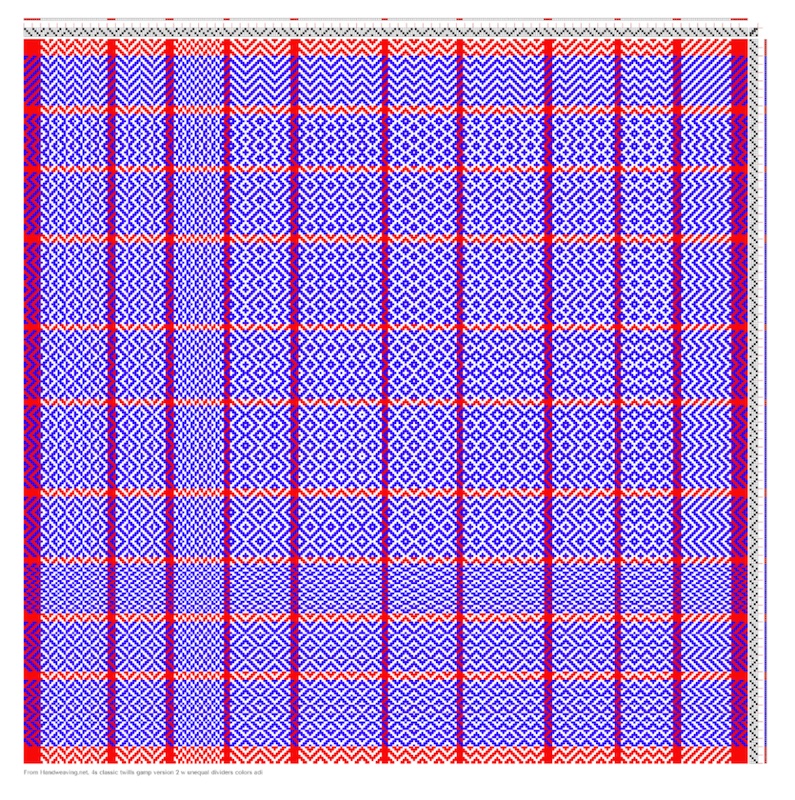
Think of it as creating a matrix of possibilities, look at all the possibilities with 10 treadling and 10 threading variations in the draft above!
Two types of gamps: reference vs. project
Not all gamps serve the same purpose, and understanding the difference will help you design more effectively.
Reference gamps: your menu for future projects
Reference gamps prioritize function over form. They’re meant to be instructive and informative rather than beautiful or usable. Think of a reference gamp as creating a menu now so that Future You can order up the perfect twill for whatever project you’re working on later.
With a reference gamp, you can compare:
- Visual appearance (what different twills look like)
- Physical texture (what they feel like to the touch)
- Drape (how they bend and fold)
- Thickness variations
- Dimensional changes (draw-in and take-up)
- Float lengths
The beauty of a reference gamp is that it doesn’t need to be pretty. The colors don’t need to coordinate, the sections don’t need to be attractive, and the overall design doesn’t need to be aesthetically pleasing.
Some sections might even produce fabric that isn’t viable for an actual project. That’s valuable information! Finding out that a particular combination creates problematic floats or loose fabric is exactly the kind of knowledge you want to have before you invest time in designing a major project.
Project gamps: beauty meets function
A gamp doesn’t have to live on your bookshelf as a reference sample. You can absolutely weave a tea towel, blanket, shawl, or set of napkins that just happens to be a gamp. Project gamps balance beauty with the opportunity to learn about different twill structures.
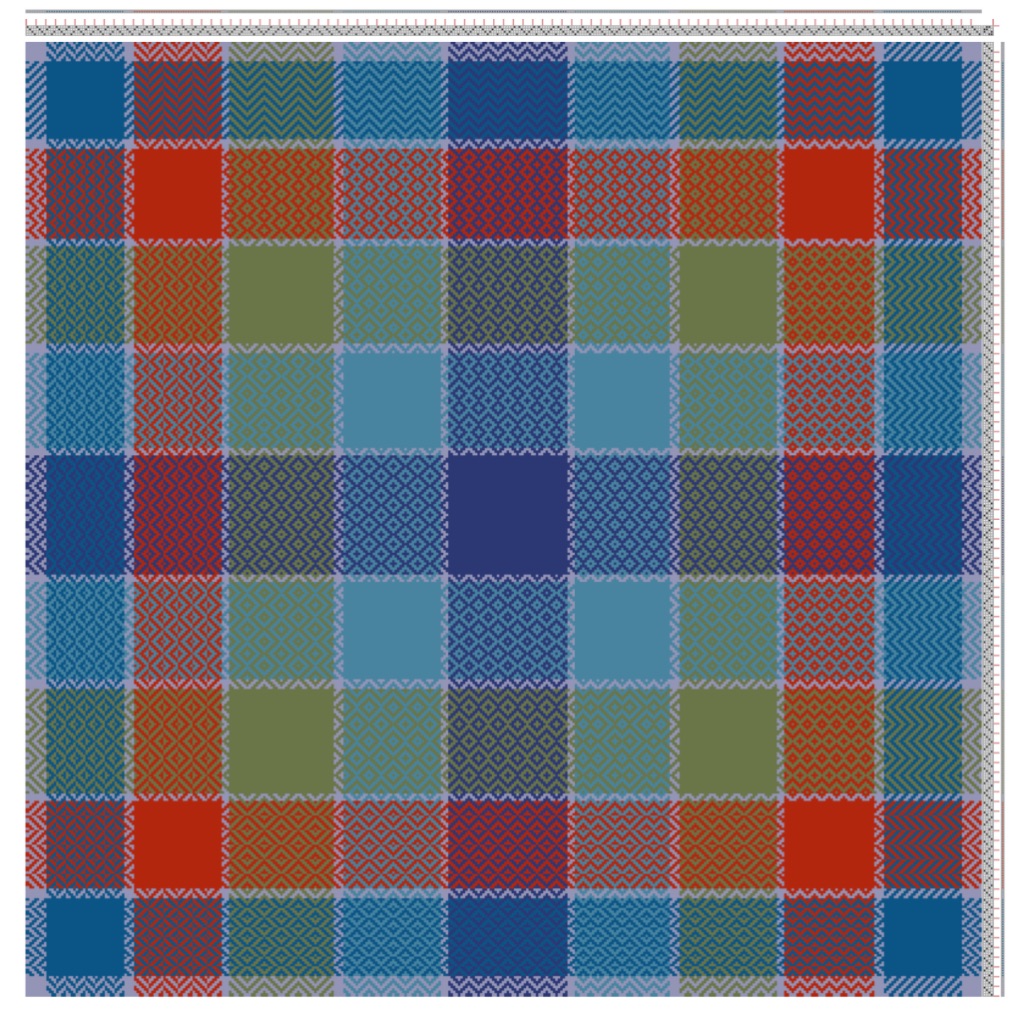
When designing a project gamp, you’ll need to pay more attention to:
- Color coordination and stripe arrangement
- Consistent float lengths across all sections
- Uniform drape and hand throughout the piece
- Overall visual appeal
- Finished dimensions and proportions
The trade-off is that you might sacrifice some learning opportunities in favor of creating an attractive, usable item. That’s perfectly fine. Different gamps serve different purposes.
Project and reference gamps are both invaluable.
Weaving software can show you what a draft looks like, but it has significant limitations. A physical gamp shows you the actual finished cloth, including:
- How yarns shift during wet-finishing
- True color interactions in woven structure
- Actual texture and drape
- Real-world float behavior
- How different combinations feel to the touch
Many weave structures look quite different in finished cloth than they do in a digital drawdown. Lace weaves, waffle weaves, and structures where yarns shift significantly can only be truly evaluated by weaving them. Even in point twills, the single thread at the tip of a point often slides underneath adjacent floats during wet-finishing, changing the appearance from what you see on screen.
Getting Started
The best way to understand gamps is to weave one. Start with a simple four-shaft classic twill reference gamp using variations like straight draw, rosepath, and Wall of Troy. Use inexpensive yarn in colors that provide good contrast.
As you weave, you’ll start to see how different threading and treadling combinations interact. You’ll discover which ones create firm, balanced cloth and which ones are loose or drapey. You’ll identify your favorites and learn which combinations to avoid in future projects.
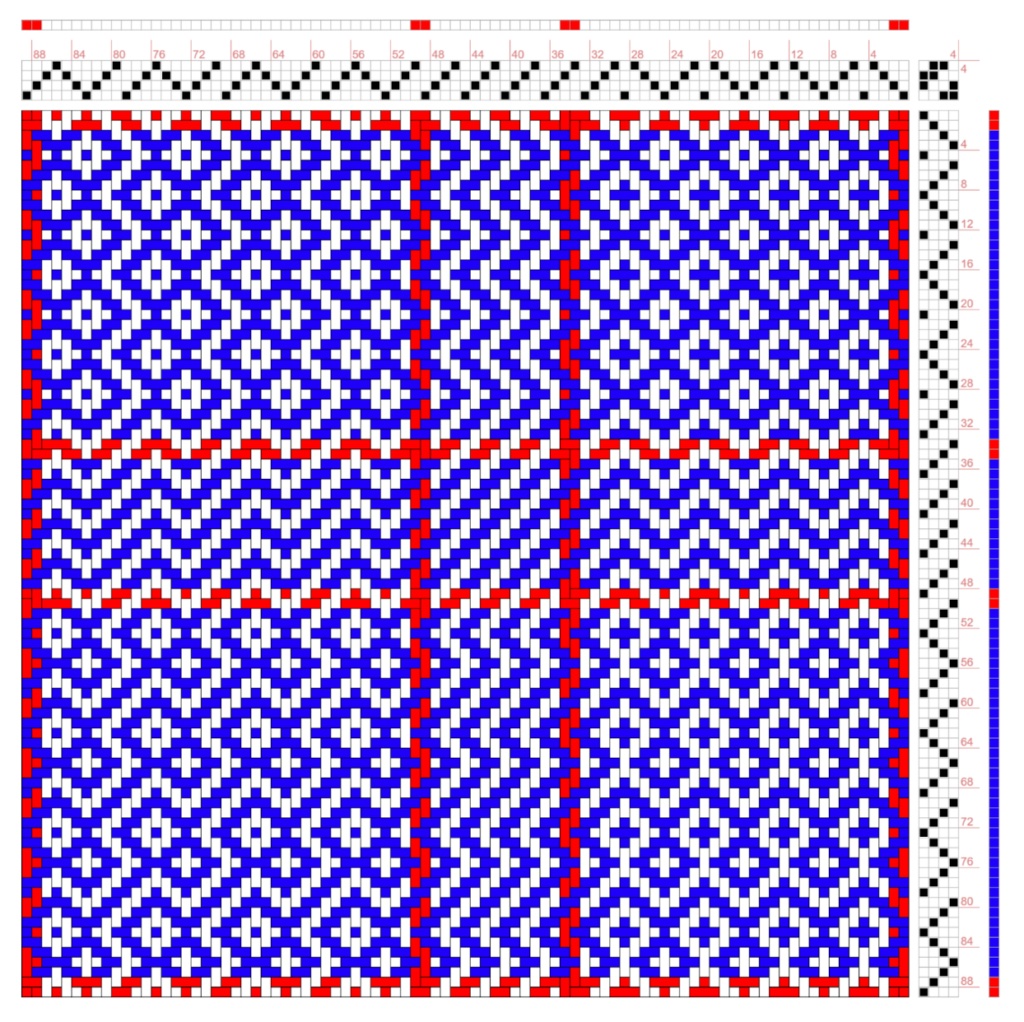
Gamp design basics: threading and treadling
In the warp (threading): Different twill variations are placed side by side in vertical stripes. These might include straight draw, rosepath, Wall of Troy, or any other variations you want to explore, even “fancy” undulating and advancing twills (classes on both of these are in our course catalog). Dividing lines (usually straight draw in a contrasting color) separate each variation.
In the weft (treadling): Different twill variations are woven one after another in horizontal stripes. These can be the same variations used in the threading, or completely different ones.
The result: Where each threading stripe crosses each treadling stripe, you get a distinct square showing exactly how that particular combination behaves.
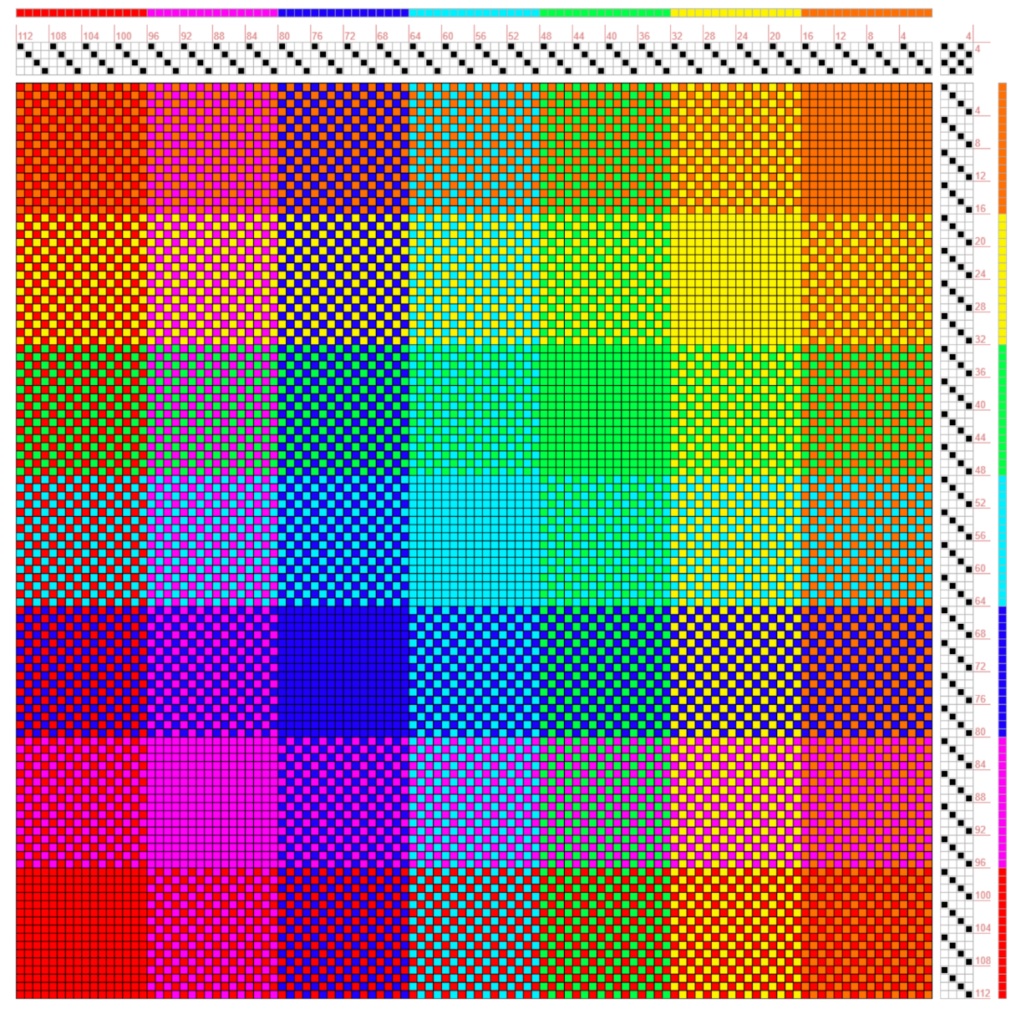
Gamp design basics: color mixing
In the warp and weft: select a palate from yarns of similar thickness. The intersections can be as small or large as you need as long as there is enough area to isolate.
Color Selecting: Brilliant rainbow hues are stunning for a general reference, but the gamp will be even more helpful in your designs if you weave one in hues you like to work with. Consider adding muted or neutral yarns and black, white and different greys.
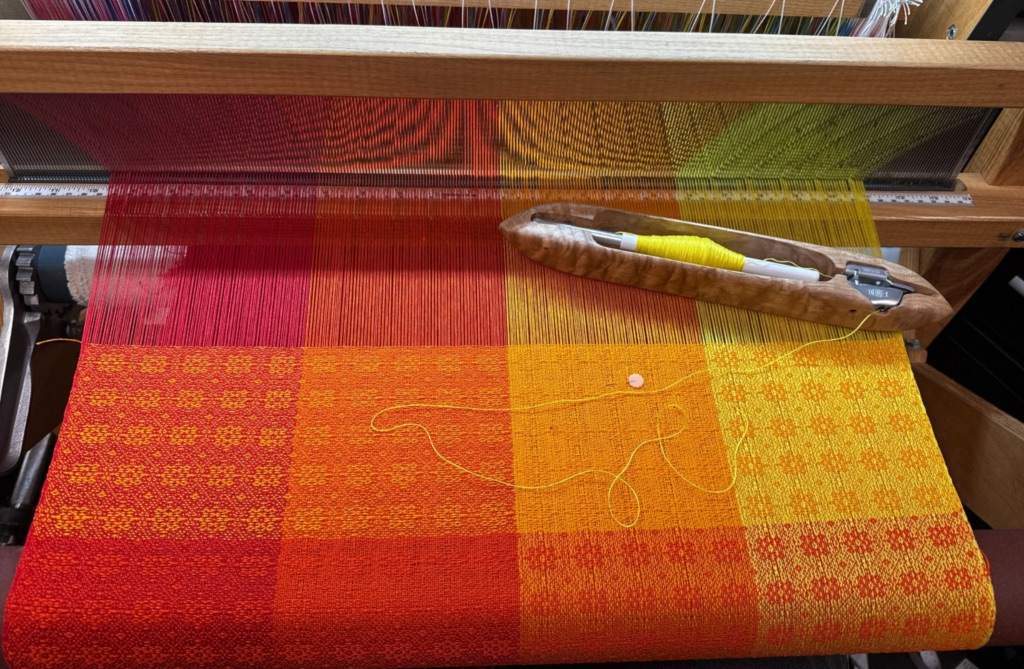
The result: Every color is woven as a warp or weft, intermixing and providing valuable information about how color works in cloth. Consider weaving your color gamp in a variety of structures, plain weave, 2:2 twill and 1:3 twill are excellent options if you don’t have a draft in mind.
The beauty of gamps
Gamps transform abstract possibilities into concrete, real-world knowledge. Every gamp you weave builds your library of reference samples and deepens your understanding of how twills work.
Whether you’re creating a purely functional reference sampler or a beautiful project that happens to teach you something along the way, gamps are one of the most efficient and valuable sampling methods available to weavers.
So grab some yarn, choose a few twill variations that intrigue you, and start designing your first gamp. Future You will thank you for it.
From the Course Catalog:

Twill Gamps – design your own structural gamp with a variety of twills.
Color Gamps – use color to design both decorative and funtional gamps.